Be Calm and Do Calm: The Secret To Parenting Junior Performers
Liane Langendorff-Bax ·

As a parent of a child who performs under pressure, have you ever asked yourself:
- Why does my child perform better in practice than during competition?
- Why do nerves suddenly take over?
- Why does one mistake spiral into frustration or negativity?
- How can I support my child without adding more pressure?
If so, you are not alone!
Performance environments can be mentally demanding for young performers, and while physical and technical training often receives the most attention, mental performance fitness is just as important for long-term growth and healthy development.
A child cannot grow their ability to perform under pressure without the freedom to struggle, adapt, and try again.
Performance is More Than Talent
A child’s performance depends on multiple factors: physical development, technical skill, tactical understanding, and mental fitness.
At younger ages, physical and technical foundations often dominate performance. But as pressure, expectations, and competition increase, mental skills begin to play a larger role.
One of the biggest challenges junior performers face, is learning how to manage two important mental states:
- A calm, present, performance-focused state (“flow”)
- A reflective state used for learning, planning, and evaluating
Both are important. Problems arise when children get stuck in the wrong mode at the wrong time, such as overthinking during competition or failing to reflect productively afterward. This is where mental performance training becomes essential, but parents play a much larger role in their child’s mental states than is commonly perceived.
Why “Be Calm and Do Calm” Matters
One of the most overlooked influences on a child’s performance is the parent’s emotional state. Research shows that children are incredibly sensitive to the stress, body language, tone, and emotional reactions of their guardians. When pressure rises, your child doesn’t just manage their own nerves — they often absorb yours as well. That’s why one of the core ideas we teach parents is simple: Be calm. Do calm.
When emotions are high, even good advice can become noise. So, before helping your child through a difficult moment, ask yourself these two questions:
- Am I calm enough to help?
- Is my child calm enough to receive guidance?
If the answer is “No” to the first question, it’s time to be calm first and manage your own thoughts and emotions before you manage your child’s.
If you are calm, but your child is not, it’s time to do calm and create the conditions in which your child can achieve a quiet mind. Doing calm refers to an approach that builds on research into optimal parenting for children who regularly perform under pressure. The CALM framework, created by Dr. Bax, turns that evidence into actionable suggestions.
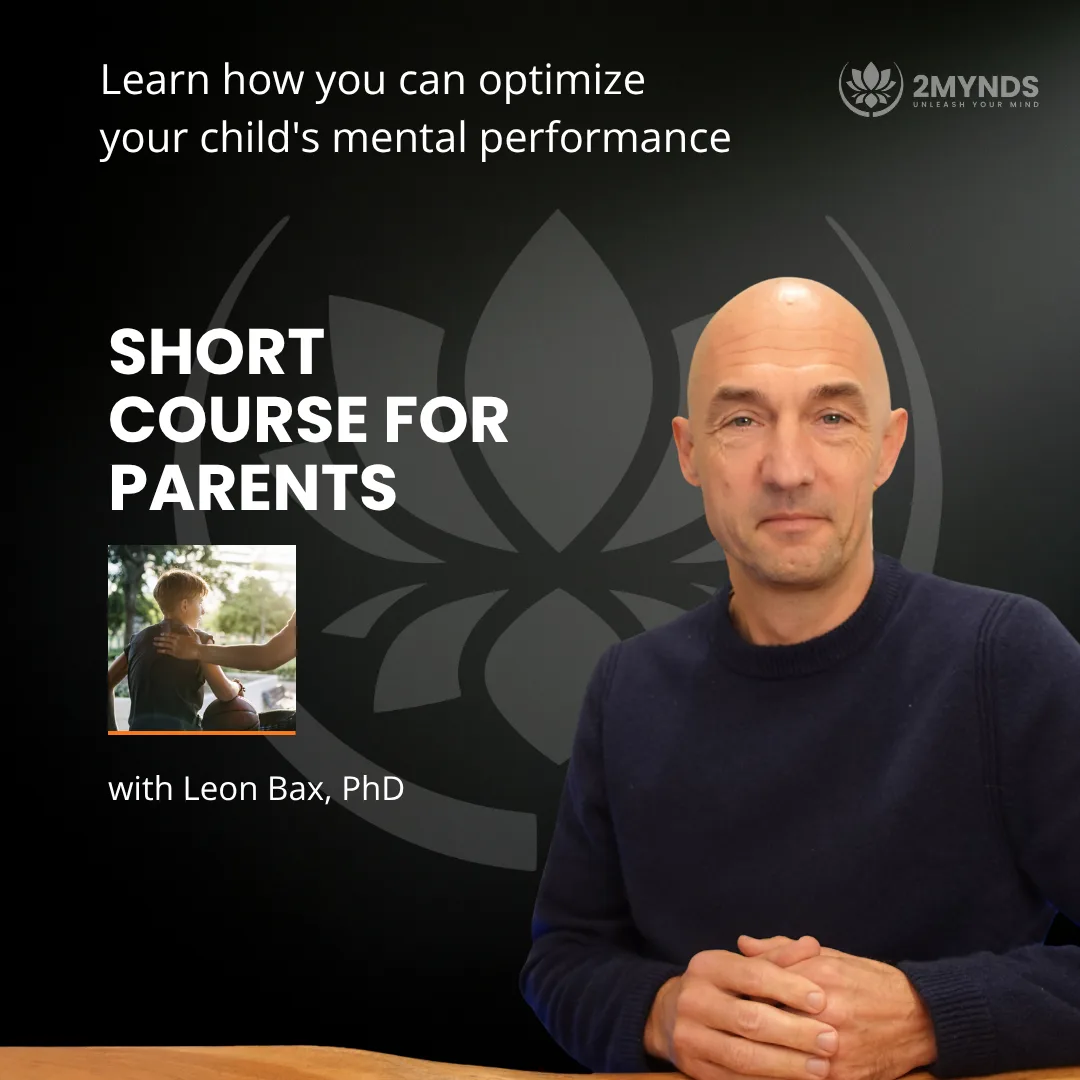
Looking For PRACTICAL GUIDANCE?
Join 2Mynds founder & CEO, Dr. Leon Bax in an engaging short course for parents! Unlock insights that can elevate your child’s performance and mental fitness!
Sign up and step into a new world of mental performance for you and your child!
Autonomy-supportive parenting and the CALM Framework
While it is natural for parents to want to protect children from mistakes and disappointment, children develop resilience, problem-solving ability, and confidence when they are allowed to struggle, adapt, recover, and try again. Research consistently shows that autonomy-supportive parenting (guidance combined with empathy and freedom) leads to healthier long-term outcomes than highly controlling approaches.
The CALM framework is a practical set of four actions, designed to help parents support junior performers without becoming overly controlling or emotionally reactive. The framework focuses on four key parental activities that are authoritative, but not authoritarian:
- Check In
Understand your child’s mental struggles. This is about asking the right questions at the right time. - Arrange
Create opportunities for growth and preparation. This is about scheduling activities that cover all four pillars of performance: physical, mental, technical, and tactical. - Let Them Play
Facilitate autonomy and resilience. This includes sitting back and being a calm, stable foundation from which a child can grow. - Mentor
Providing calm, constructive guidance. This covers structured exchanges that turn feedback into an active learning experience.
For more details, we recommend the 2Mynds’ Short Course for Parents.
Let Your Child Train
Lastly, even when you do everything right as a parent, if you want to see your child thrive under pressure, they’ll have to find comfort in the discomfort that comes with it. Every child treats this differently, but the best approach to addressing mental challenges is progressive (step-wise) training. This means that journaling, consulting psychologists, reading books, and watching motivational videos are all useful, but they don’t train skills in a stepwise manner with progressively challenging tasks.
That’s why our approach and app, FLOW 255®, integrates mental training with physical activity and controlled stress exposure. It trains young performers to regulate attention, emotions, and recovery while physically challenged — helping skills transfer more effectively into real performance situations.
The result is a more functional form of mental training: less theory, more application. To learn more about how that works and try it for a whole month for free, check out the FLOW 255 introduction.
Peak performance literally flows and becomes a natural consequence when falling is no longer seen as failing.
Sign up FOR THE SHORT COURSE!
Support your child’s performance journey with greater clarity, calmness, and confidence! Our Mental Performance Short Course for Parents was designed specifically for parents of junior performers in sports, academics, music, and creative performance environments, and inside the course, Dr. Leon Bax covers:
- Modern mental performance optimization
- Practical tools for performance-related interactions
- The C-A-L-M framework for parents
- Common mental struggles in junior performers
- Healthy performance support strategies
- Practical next steps for your child’s development
The course is short, evidence-based, and designed for immediate application.