SPEC Your Mind: Insights For Mental Change
Leon Bax ·
Making effective changes to your behavior becomes a lot easier if you understand what is occurring, why, and how you can move to productive alternatives.
Got Patterns?
As humans, we behave in patterns. That’s because our brain works in patterns. A memory isn’t stored as a file, but rather as a micro-pattern of brain activity. Patterns simplify our interactions with our surroundings because similar stimuli get lumped together (as a pattern), and you don’t have to learn how to react all over again. For example, when we learn that a campfire isn’t very comfortable to step into, our brain quickly generalizes that information to “don’t put your finger into the flames of a candle.” Many patterns are beneficial to our well-being, but in the same way that productive patterns develop (through association), so do unproductive ones. However, unproductive patterns share an interesting trait that many productive ones miss: they involve some degree of distorted thinking. Psychologists have devised a technique to identify and address those distortions, called cognitive restructuring. The SPEC approach we use at 2Mynds is related to that technique. Before we dive into how you can use our SPECs, let’s take a quick look at cognitive restructuring.
CHANGE THE VIEW
Cognitive restructuring is a technique that psychologists use to help people change unhelpful thinking styles. Typical steps in cognitive restructuring include recognizing thought patterns, studying them, crafting alternatives, and implementing productive ones. Psychologists use various approaches to initiate and guide the restructuring process, including Socratic questioning, sequence models, and view reframing. Our SPEC model and the two techniques we use in Flow 255 are derived from psychological techniques to fit performance-driven situations. Our approach not only covers thoughts but also the triggering situations, behavioral patterns, and emotions.
MAP YOUR MENTAL SPECs
SPECs is an acronym for a mental model developed at 2Mynds to facilitate quick and effective assessments of all aspects of unproductive performance patterns. Initially created for professional athletes, it applies to everyone involved in high-stakes activities, including academic and business settings. SPEC stands for Stressor or Situation, Pattern, Emotion, and Cognition. The full acronym is SPECs, because you should define at least two: one for your struggle and one for your ideal solution or alternative. This helps you map your problem to an opportunity and, with our app or mental coach, define the steps to make the transition.
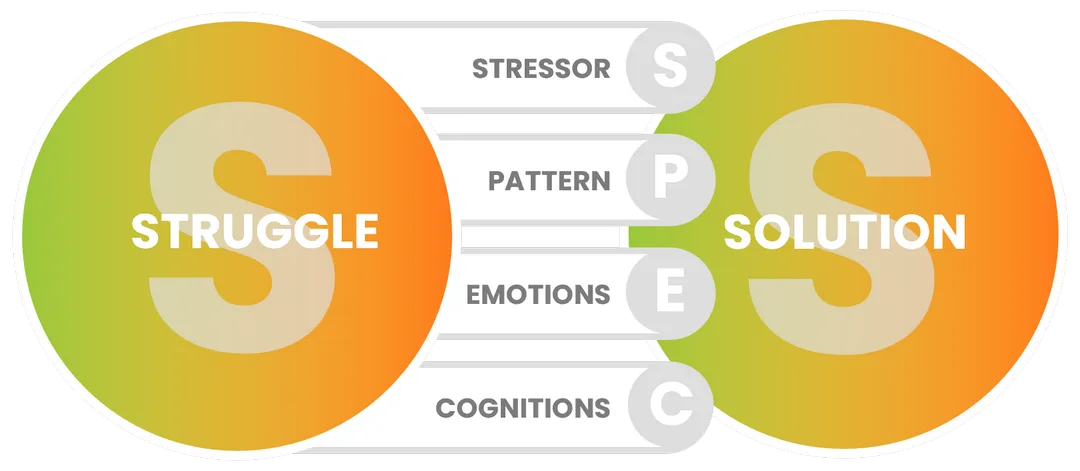
S – Stressor
Stressors are events that challenge a physiological status quo. Depending on how they are interpreted and dealt with, stressors can cause stress, but they don’t have to. In sports, we often refer to a stressor as a situation of pressure. For stressors, we typically describe only the struggle and don’t include a solution, because situations are rarely controllable.
Examples (tennis)
– Struggle: You are about to serve at 15-40 and 5-5 after having been up 5-2.
P – Pattern
A pattern is a recurring behavioral process that, in the context of mental fitness training, is unproductive or interferes with well-being or performance.
Examples (tennis)
– Struggle: Your arms and legs shake, resulting in more-than-average double-faulting.
– Solution: Steady arms, grounded posture, and high-quality second serves.
E – Emotions
An emotion is an arousal experience that is mediated by physical and cognitive processes. Emotions are different from thoughts. So, feeling or experiencing fear is not the same as thinking fearful thoughts. Emotions are typically associated with activity in the amygdala, a rudimentary region of the temporal lobe.
Examples (tennis)
– Struggle: You feel anxious, fearful, and uncomfortably tense.
– Solution: You feel excited, engaged, and determined.
C – Cognitions
Cognitions refer to thoughts, which can be rational or irrational verbalizations that can be quiet or spoken. Although thoughts and emotions are both complex in terms of brain activity, thoughts are characteristically associated with activity in the left hemisphere and cortex.
Examples (tennis)
– Struggle: Thinking “I cannot give this away. I’d better not hit a double fault!”
– Solution: Thinking: “Another opportunity to commit to my practice. Let’s go all-in!”
The app integrates SPECs assessment into its TRACK component and links it to the goals and targets you define there.
Planning Next Steps: SMART TARGETS
Once you have clearly defined your SPECs struggle and solution, planning next steps and setting effective targets is easy. Our app helps you define and track your targets to keep you accountable. It also reminds you to update them regularly as you progress. When you set them up, it’s helpful to define short-term and medium-term targets and work towards achieving both. When defining them, use the SMART approach: make your targets Specific, Measurable, Achievable, Relevant, and Time-bound. That means your target should not be too general or vague, not too hard, easy to verify that you achieved it, and planned for a specific time frame. Within our app, we also recommend our version of the KISS principle (Keep It Simple and Short), and we limit target definitions to one sentence or fewer than 35 words.
ELEVATE YOUR MENTAL FITNESS
Defining your mental deficiencies, identifying effective alternatives, and outlining ways to address your challenges is highly insightful. However, knowing what to do doesn’t mean you can do it. This is where the app shines – it helps you train skills and thought patterns under pressure! For example, it helps you train to project optimal SPECs as your body experiences progressively increasing levels of stress. Meanwhile, you will also progress through variations of techniques at increasing difficulty levels. This way, your brain is primed to maintain multiple perspectives and execute optimized behaviors when it counts!
SPEC Mapping For Teams
Defining individual SPECs and mapping them to potential changes and skill training to achieve those changes is not only useful for individuals but also an extremely valuable tool for creating a constructive team environment. This applies to both sports and corporate environments. Defining individual SPECs in relation to team dynamics and comparing self-reported SPECs with externally perceived SPECs (e.g., by coaches or managers) can significantly improve team cohesion and performance. Contact us to set up a SPECs assessment for your organization.
Try Flow 255 For Free
Our app represents a unique, innovative methodology and technology for developing mental fitness. It’s a training-based approach that develops mental strength through targeted repetitions under optimal conditions. We understand that trying something new can be challenging, so we offer a one-month free trial with our subscriptions. Try it, put in the work, and if you train your mind like you train your body, you’ll see results in no time!