How Peak Performers Can Build Routines that Stick
Leon Bax ·

I fear not the man who has practiced 10,000 kicks once, but I fear the man who has practiced one kick 10,000 times.
Bruce Lee
The terminology of repetitive behaviors: Not all habits are created equal
Human beings are creatures of habit. Habits are not limited to humans: virtually every animal on the planet displays some form of habitual behavior. Cats return to their favorite spots, dogs prefer specific routes, and even birds show behavioral patterns that exhibit a level of automatism and repetition. This is not surprising, considering that brains prefer storing neural patterns over storing neural signals.
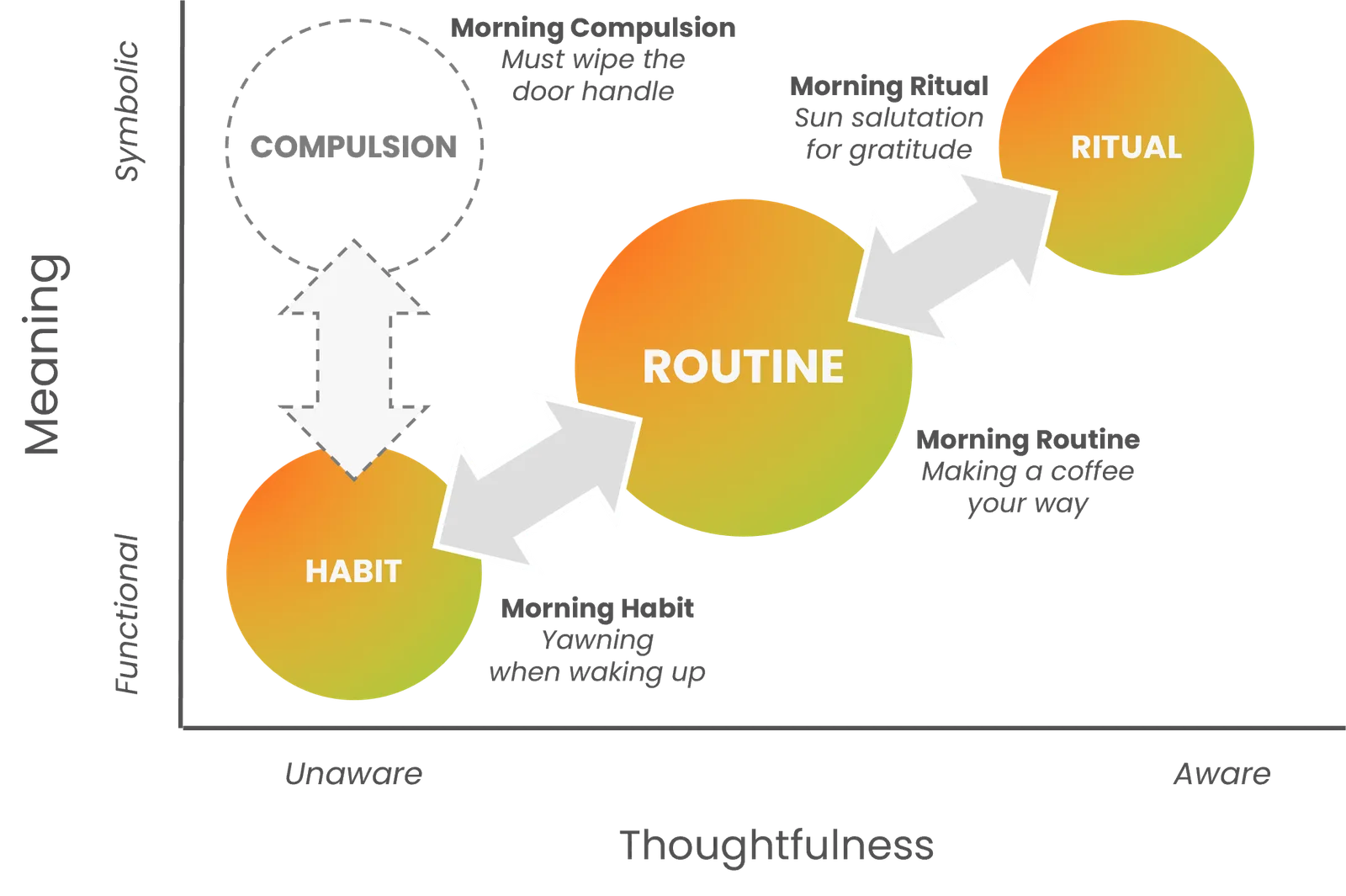
Not all habits are the same, but a common feature of habits is that they lack a purposeful intent. They also tend to have an immediate functional or dysfunctional impact that derives from the activity itself. For example, when and how you brush your teeth is a habit. Doing it will not require much conscious thought, and depending on how you do it, it can either help or harm your dental health.
When habits are given purpose and designed with the intention of optimizing behavior, they become routines. Routines involve more conscious involvement, and their effect may be a combination of the activity itself and its association with cognitive or emotional aspects. That means that while we may have dysfunctional habits, our routines typically don’t have dysfunctional effects (although they may have no effect if they are badly designed). While many people use the terms “routine” and “ritual” interchangeably, a ritual differs from a routine in that its meaning and impact are derived from its symbolism, i.e., what it represents. A great example is baptizing someone: there is clearly no intent to wash someone, and nobody gets any cleaner or fresher. However, it can have a profound impact on the person and everyone else involved – purely based on what the action represents.
There is one more repetitive behavior that has some unique characteristics: compulsions. Compulsive behaviors can start out as being functional, but their symbolic power becomes so dominant that they lose their connection to that function. Rather than controlling a function, they are controlled by dysfunction. Because they derive meaning outside of function, compulsions, and to some extent rituals, lack the flexibility and purpose that we find in good routines.
The value of routines in sports
Routines are everywhere in sports, and you only have to turn on the television to see professional athletes execute their routines. There are many different types of routines, and in the Flow 255® system of 2Mynds, we distinguish preparation, performance, and recovery routines.
Some athletes have spoken out about their routines. Tiger Woods has more than once described how his father helped him develop a pre-shot routine at an early age. Michael Jordan used a particular sequence of movements before a free throw. Soccer legend Pelé was known for doing a visualization routine before games. Boris Becker, somewhat famously, had a habitual pattern with his tongue that Andre Agassi used to predict where Becker might serve.
Beyond the fact that many professional athletes attest to the value of routines, there is thorough evidence that routines increase performance. A systematic review and meta-analysis by Rupprecht et al. shows consistently positive impacts of pre-performance routines across different sports, levels, and pressure conditions.
The value of routines in academic and corporate settings
While routines are often most visible in sports, their value extends far beyond athletic performance. For students and professionals in high-pressure corporate environments, routines are equally crucial in channeling focus, reducing stress, and sustaining long-term performance.
For students, routines create a framework that minimizes decision fatigue and provides consistency in environments that are often unpredictable. In fact, it turns out that consistent study times and preparation routines improve both retention and recall, particularly under exam pressure. By embedding preparation and recovery practices, students can optimize both learning and resilience.
In corporate settings, routines are just as vital for maintaining performance under pressure. Professionals often face high cognitive demands, frequent context switching, and relentless decision-making. Purposeful routines help establish control and reduce mental clutter, allowing individuals to perform under pressure more effectively. Just as athletes benefit from preparation and recovery routines, so do executives and knowledge workers; it all contributes to higher performance and lower burnout.
Just as in sports, the intentional design of routines in academics and professional life turns everyday habits into powerful tools for sustained high performance.
The anatomy of a good routine
A good routine, whether it is before, during, or after a performance, has a particular and consistent anatomy. It has three components or dimensions: (1) situational, (2) physical, and (3) mental. They are all essential cogs in a routine’s machinery.
The situational part of a routine includes where you choose to do the routine and what you do with materials and tools. The physical component refers to your posture and movement, and the mental component involves the effective application of your mental fitness.
An impactful and efficient routine not only addresses each component but also ensures that each component reinforces the others. For example, suppose the purpose of a routine is to calm racing emotions and reduce tightness due to perceived pressure (say, during a short break when the ball is not in play in a ball sport, or just before a presentation or exam for a corporate professional or student). In that case, the performer’s posture, movement, and use of materials should also be calming. The most common mistake with routines, however, is the lack of structure and quality in the mental component.
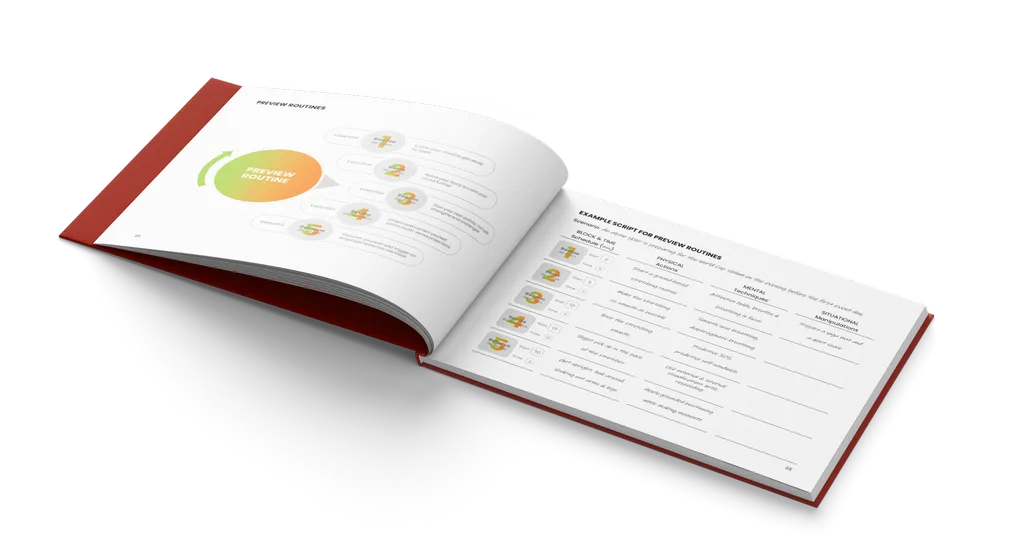
The mental component of a routine is the most powerful part. Even if you get the situational and physical aspects right, if your mental skills are poor or not incorporated into your routine, your routine will remain empty and will not serve its purpose, particularly under pressure. At 2Mynds, we utilize the five core mental skills from the Flow 255 system as building blocks for the mental component of our routines. The five core skills (realize, relax, reason, revise, refocus) have a specific order that also determines the order of the routine blocks. Depending on the routine and situation, one or more components can be skipped, but their order should remain unchanged. In the book Building Performance Routines, you’ll find routine cards and scripts that help any performer construct effective routines from the right building blocks.
Routines need training
If you want routines with impact, you must ensure that the skills you apply in the five parts of the mental component are well-trained. Your routine will be as strong as its weakest link, so each skill deserves attention. While many see the application of routines as training, that is a misconception. Good training is an investment that involves straining your abilities, and as a result, it typically will (and should) reduce performance immediately after the training. Routines have a different purpose: they are meant to reap the benefits of training and get a return on the training “investments.” Hence, immediately after good routines, your performance should increase.
Let’s Develop Your Routines
Ready to develop your routines? Start your journey towards thriving today—check out our solutions! If you are a corporate executive, a sports academy owner or coach, a college coach, or a performance psychologist interested in our options for teams, book a free consultation to learn more!
Check out our routines book
The book, Building Performance Routines: Empowering Habits Towards Impact, by Leon Bax, is now available in a coil-bound format on our publications page and in regular paperback format on Amazon. This book follows Leon’s publication, “Find Your Flow: Thrive Under Pressure,” which focuses on the theory behind performing under pressure and is also available on Amazon. As an Amazon Associate, 2Mynds earns from qualifying purchases.