Angry? Preventing Beats Venting!
Leon Bax ·

It is commonly suggested that venting reduces anger and aggression. Multiple scientific studies now show it does not.
Just Let It Out?
Most high-performance and professional athletes set the bar high for themselves. More often than not, it turns out to be too high. A famous example is John McEnroe. Billie Jean King noted: “John is a perfectionist! In his head, it’s never good enough.”
While perfectionism can have its benefits, for many, it comes with frustrations that negatively affect performance. McEnroe realized it was a problem: “I was melting down. Thirty-seven psychologists didn’t help. It felt like there was no way it could get worse. But that proved to be incorrect…”
When faced with frustration and anger, a common suggestion is to let it out: take a moment to vent the frustration and get back to business. Although verbal or physical venting may create a feeling of relief or release, does it actually reduce the anger? Does punching a bag in anger get rid of the negative energy? Does breaking a tennis racket or throwing a golf club help you reset? We finally have a body of research that provides an answer.
THEORIES OF EMOTION
Before we dive into anger management research, it is useful to consider what emotions are. The predominant theories of emotion see cognition and arousal as core components of an emotional experience. The cognitive component is also referred to as an appraisal response: emotion as a reaction to the evaluation of a situation. For example, if an identical situation is evaluated differently due to personal or cultural differences, it will lead to a different emotional response. In a way, your appraisal ‘colors’ the emotion. The arousal component of an emotion is different in that the conscious experience of an emotion comes from an autonomous perception of a bodily state. In a way, it’s a subconscious appraisal of the body’s physiology rather than of a situation. Your brain will associate some types of arousal with one emotion and other types with another. Considering that both cognition and arousal components play a role in emotional responses, it makes sense that interventions that are meant to impact anger will address one or both of these components.
STUDYING ANGER MANAGEMENT
Interventions for anger management have been studied for decades. However, due to random and systematic differences between the studies, the results tend to be heterogeneous, and it can often be hard to draw conclusions. In addition, studies are often subject to dissemination bias, i.e., what you read is only part of the story. The rise of the internet and AI has only made that worse – anyone can appear to be an authority, and there is no vetting or systematic weighting of evidence. A scientific approach called meta-analysis attempts to address those challenges (among others) and has become the cornerstone of the formal evidence assessment in medicine, social sciences, and beyond. Lucky for us, a thorough meta-analysis on anger management activities was published recently.
In their meta-analysis, Kjaervik and Bushman assessed 154 reports of controlled studies involving 10,189 participants. Their primary objective was to compare the effects of arousal-increasing activities and arousal-decreasing activities to manage anger. In simpler terms, they assessed what worked better: physically acting out (venting) versus physically calming down, both with the intent to reduce the cognitive and emotional stress associated with frustration and displeasure. Common arousal-increasing activities that were studied were hitting a punching bar, jogging, and cycling. Arousal-reduction activities included deep breathing, mindfulness, and meditation. They combined the results of the studies by looking at a generalized effect size (Hedges’ g) and assessed not only the common effects of the interventions but also whether any variables modified that effect.
NOT ALL ANGER MANAGEMENT IS EQUAL
The primary conclusion of the meta-analysis is quite striking: arousal-decreasing activities consistently decreased anger and aggression. Moreover, the effects of techniques that decreased arousal were stable over time across genders, races, ages, and cultures, regardless of how and in what setting (digital platforms or therapists) the methods were applied. In contrast, arousal-increasing activities were not only generally ineffective; there was no pattern in the variation of the impact. In other words, punching a bag or going for a run may be good for you physically, it does not reduce feelings of anger or anger-related arousal levels.
In summary, the scientific evidence does not support strategies such as venting and activities that involve increased arousal. What may feel like a release initially does not have a profound or lasting positive impact. Instead, meditative approaches that “turn down the heat” are shown to be more impactful in releasing cognitive and emotional discomfort.
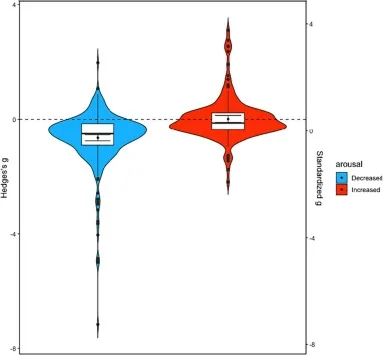 From Kjaervik & Bushman. Violin plots showing the distribution of effect sizes around a horizontal line of no effect (Hedges’ g = 0). The violin plots also contain weighted point estimates and its confidence intervals. Arousal-decreasing interventions (blue) lead to a substantial and clinically significant reduction in anger, whereas the overall effect of arousal-increasing interventions (red) trends around a Hedges’ g of 0.
WHAT IT MEANS
The main takeaway from this meta-analysis is that if your natural reaction to a frustrating event is to vent, it would be wise to change that tendency. That does not mean you should simply not vent (the anger would still build up). In fact, another large body of research shows that anger rumination can have critical adverse effects. Instead, you should learn to use arousal-decreasing techniques, such as mindful, open monitoring (being aware of undirected attention), focused internal monitoring (directing attention to breath, tension, posture, movement), physical relaxation (smooth breaths, nose breaths, diaphragmatic breaths, active relaxation), and suggestive relaxation (projecting calmness, pleasantness, and positive emotions). All these techniques will improve with training, and they will deteriorate without it. In exercise physiology, that is sometimes referred to as the principle of reversibility (“Use it or lose it”). This brings up an important point: what should good training look like?
USE ‘REAL’ TRAINING
For workouts, including mental ones, to become training, they should adhere to training principles from exercise physiology. This means the exercises should be done in a challenging way, and that challenge should progress over time (progressive overload). In addition, training must be regular and include recovery periods. Lastly, the workouts must work from basic training of specific parts to functional exercises. This functionality aspect is particularly crucial for mental training.
When you train your mind, it’s not so much how many reps but rather under which conditions those reps are done. If they are done while your body’s physiology is unchallenged and calm, the skills are unlikely to translate to functional situations of stress – when you need the skills the most. Basically, if you never train your skills under stress, they won’t work under stress. So, meditating in a quiet room will not do an optimal job for functional anger-management applications, and mental fitness training that has its roots in exercise physiology is required. Flow 255® by 2Mynds is one of the few mental training systems that make sure you progress to stress.
PREVENTING BEATS VENTING
Another key takeaway from the meta-analysis is that the effect sizes are relatively small when you look at the original scales that were used to measure effects (rather than Hedges’ g). This is somewhat under-addressed in the discussion of the meta-analysis report, but it is important because it underscores that once anger is present, it’s hard to get rid of it. This shouldn’t come as a surprise as, generally speaking, preventing a problem is always better than managing it.
While you will need some of the same arousal-decreasing skills for prevention, changing one’s cognitive appraisal of a situation plays a more crucial role. This is because a characteristic of anger is a loss of cognitive logic. Consequently, appraisal-changing approaches are doomed to fail under high levels of stress (unless they are trained under such levels of stress). Conversely, prevention always takes place before the arousal levels hit their peak, so appraisal adjustments are much easier to integrate.
TRAIN YOUR PERSPECTIVES
When it comes to the appraisal of challenging situations, different perspectives can lead to different appraisals and, subsequently, to different emotions. Since perspectives are associated with mental attributes that are somewhat characteristic of a person (not fixed, but sticky), cognitions and emotions themselves tend to reoccur (as patterns) in certain situations. Such patterned responses are hard to stop, but they can be replaced. In the case of anger prevention, negative perspectives can be reframed into positive (or realistic) ones.
With regard to anger, common negative attributes are perfectionism, melodramatic tendencies, and insecurity. Common perspectives associated with these attributes are: “I should be way better than this,” “This is the worst day of my life,” or “I cannot do anything right.” Adopting different perspectives is, in most cases, not as simple as making a conscious decision to change. Patterns have a physical and mental (cognitive and emotional) component, and they are stubborn, particularly when under pressure. If you have negative patterns that repeat themselves under specific conditions, you can generally not get some good advice, add some insight, and expect a different pattern based on that.
Adopting a different perspective can’t be considered training in and of itself. It’s instantaneous and does not require any of the training principles. However, making the new perspective stick and making sure it elicits an associated positive emotional response and positive behavior requires techniques, exercises, and repetitions, i.e., training. This is especially true for negative emotions and patterns that occur when someone is required to execute a critical action in a situation of pressure. While police and military personnel, critical care staff in hospitals, and professional athletes are prime examples of people who execute critical actions under pressure, what is perceived as critical and pressure is subjective. So, in a sense, we may all deal with frustrations under pressure in one way or another. Hence, we can all benefit from training our control over perspectives and emotions in ways that work when it counts. By definition, that means you must progress to stress and get out of comfort with impactful workouts.
A FINAL NOTE TO PERFECTIONISTS
While the evidence indicates that acting out anger or frustration is more likely to make matters worse, it is often still justified by the idea that it’s inevitable if you are sufficiently perfectionist. While that statement may make sense at face value (the higher your expectations, the more often you might be disappointed), a deeper look reveals its fallacy.
If you are genuinely striving for perfection, you will not let your anger or frustration take control over your performance or well-being. In other words, those who say, “I acted out because I care so much about playing to my potential,” are really saying, “I acted out because I wasn’t perfectionist enough to figure out how to control myself and optimize my performance.” So, to all perfectionists out there: embrace your perfectionism but add proper training to prevent and manage your frustrations optimally!
PRIMARY Reference
https://www.sciencedirect.com/science/article/pii/S0272735824000357
About the author
Leon Bax, PhD is a clinical epidemiologist and medical informatics expert who spent years applying meta-analytical models to complex medical decision processes. He transitioned from optimizing wealth in drug development to advancing health in society, and he is the founder of 2Mynds, a mental fitness company that helps high-performance athletes thrive at life under pressure.